
During leadership school in the Air Force, one of the first things I noticed was how intentionally uncomfortable the environment felt.
The conversations were difficult.
The personalities were intense.
The social pressure was constant.
Even simple interactions sometimes felt mentally exhausting because the entire purpose of the course was to push people outside of their normal ways of thinking and communicating.
At first, I honestly hated it.
Most people naturally want comfort. We want certainty. We want situations where we already know we can succeed. We want routines that feel familiar and safe.
But one of the instructors said something during the course that stayed with me long after it ended:
“If you want to keep growing, you need to stay uncomfortable.”
At the time, I thought it sounded a little extreme.
I remember thinking:
Isn’t the whole point of success to eventually become comfortable?
A better position.
More money.
An easier schedule.
Less stress.
That’s what most people spend their lives chasing.
But over time, I realized she was right.
Almost every meaningful period of growth in my life came from situations that initially felt uncomfortable, stressful, uncertain, or difficult.
Growth Requires Friction
The older I get, the more I realize that growth almost always comes with some form of friction.
There is nothing comfortable about:
- difficult conversations,
- uncertainty,
- failure,
- pressure,
- public speaking,
- leadership,
- criticism,
- or pushing yourself physically and mentally beyond your current limits.
But those are usually the exact situations that force people to grow.
The most obvious example for most people is probably fitness.
There is nothing comfortable about sore muscles, exhaustion, or pushing through difficult workouts. But most people also understand that the workouts requiring the most effort are usually the ones that create the most growth over time.
I think life works the same way.
People who become great communicators usually went through years of uncomfortable conversations.
People who become strong leaders usually endured pressure and uncertainty.
People who build meaningful things usually fail repeatedly before they ever succeed.
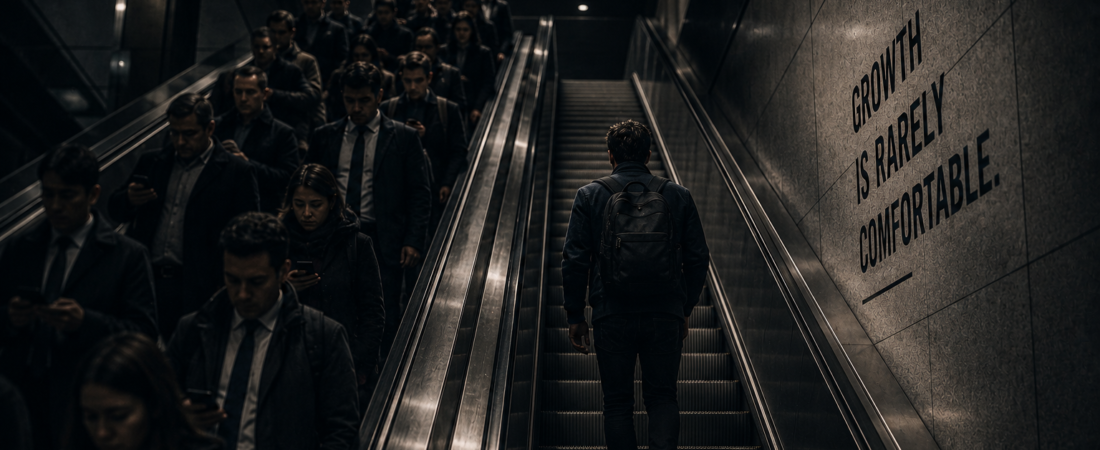
Growth rarely feels comfortable while it is happening.
A lot of long-term growth comes from learning how to continue moving forward even when situations become uncomfortable or emotionally difficult. That’s a huge part of why discipline matters more than temporary motivation.
Comfort Does Not Automatically Create Happiness
One of the biggest realizations I’ve had in my own life is that comfort does not automatically create happiness.
Before I transitioned into project management and entered a completely different career field, I had become extremely comfortable in my previous role.
I knew the systems.
I understood the job.
The pressure felt manageable.
The uncertainty was gone.
At one point, I genuinely believed that reaching that level of comfort would automatically make me happier overall.
It didn’t.
Instead, I slowly started feeling stagnant.
I realized I was no longer growing in meaningful ways because I was no longer being challenged. The discomfort disappeared, but so did a large part of the drive, purpose, and growth that came with it.
That realization completely changed the way I viewed comfort.
“A ship in harbor is safe, but that is not what ships are built for.”
— John A. Shedd
Pressure Is Not Always A Bad Thing
I also think people misunderstand pressure.
There are obviously unhealthy forms of stress in life, but I’ve learned that some pressure is actually necessary for growth.
A lot of the pressure we feel comes from caring deeply about something.
Pressure means:
- the outcome matters,
- the decision matters,
- the responsibility matters.
The problem is that modern life constantly overloads people mentally, which makes healthy pressure harder to separate from unhealthy overstimulation and burnout.
I’ve experienced this heavily both in the military and in project management.
As an aerospace propulsion technician working on jet engines, there were situations where making the wrong decision could potentially affect millions of dollars worth of equipment or even put lives at risk. Later, moving into leadership and project management roles brought a completely different type of pressure.
Now I regularly make decisions that impact:
- schedules,
- customers,
- coworkers,
- finances,
- and entire projects.
Those decisions are often uncomfortable because there is uncertainty involved. Sometimes there is no perfect answer. Sometimes someone will be unhappy regardless of what decision gets made.
But over time, I realized that constantly facing those uncomfortable situations made me:
- more confident,
- more decisive,
- and better at communicating difficult decisions to other people.
The discomfort itself was part of the growth.
I’ve also learned that growth only remains healthy long term when recovery is taken seriously alongside the pressure and discomfort that come with it.

The Problem With Avoiding Discomfort
I honestly think constantly avoiding discomfort creates its own kind of trap.
The more people avoid difficult situations, the more sensitive they become to even small forms of stress and discomfort over time.
Eventually, things that once felt manageable begin feeling overwhelming.
I think modern life also makes this worse because constant distraction and overstimulation keep people from slowing down long enough to confront difficult emotions, uncertainty, and personal growth honestly.
I think this is one reason anxiety becomes so powerful for many people.
Avoidance teaches the brain that discomfort should always be escaped instead of worked through.
Over time, the fear grows larger while confidence quietly shrinks.
That’s why I think intentionally doing difficult things can actually be very healthy psychologically.
David Goggins talks about this a lot, and while some people think his approach is extreme, I do think there is truth in the idea that people grow when they prove to themselves they can handle difficult things.
Even something simple like forcing yourself to go run when you absolutely do not want to can create a powerful sense of accomplishment afterward.
Not because running itself magically changes your life, but because your brain realizes:
“I can do difficult things even when I don’t feel like it.”
That changes people over time.
Healthy Discomfort Feels Different
I think healthy discomfort usually feels like:
- pressure,
- uncertainty,
- challenge,
- responsibility,
- and emotional tension.
Not panic.
Not hopelessness.
Just the feeling that you are currently operating outside of your comfort zone and adapting in real time.
A lot of the strongest skills I’ve developed in life came from situations where I was uncertain but still forced myself to move forward anyway.
One thing I’ve learned about myself is that I’m willing to make decisions that other people often hesitate to make. That does not mean I always know the outcome will be positive.
A lot of times I genuinely do not know what will happen.
But I’ve learned that calculated risk and uncertainty are often unavoidable if you want meaningful growth.
And even when failure happens, there is usually growth hidden inside the process somewhere.
Final Thoughts
I think a lot of people spend their lives trying to eliminate discomfort completely.
But the uncomfortable moments are often the exact moments that shape us the most.
The difficult conversations.
The uncertain decisions.
The pressure.
The failures.
The responsibility.
The challenge.
That is where growth usually lives.
Comfort is not always bad.
But staying comfortable for too long can quietly stop people from growing at all.
The goal is not to constantly suffer or live under endless stress.
The goal is to become strong enough mentally and emotionally that discomfort no longer controls your willingness to grow.
Because almost every meaningful thing in life eventually requires the courage to feel uncomfortable first.