
There are days after work where I sit in my truck for a minute before driving anywhere.
Not because I am trying to be dramatic.
Because my brain feels completely maxed out.
Some days are nothing but decisions, problems, conversations, pressure, and constant mental switching. By the time the workday ends, I have had moments where I feel like I forgot how to do basic things. I’ll sit there in silence, mentally drained, trying to collect myself before moving on to the next responsibility.
And on those days, the last thing I usually feel like doing is going to the gym.
The couch sounds better.
Doing nothing sounds better.
Convincing myself I “deserve a break” sounds better.
And sometimes I have given in to that.
But I have learned something about myself over time.
Learning how to stay fit with a full-time job is not really about having extra time. It is about building enough structure to protect your health when life gets busy.
The days where I feel the most mentally drained are often the days where I need physical movement the most.
That is where my phrase comes from:
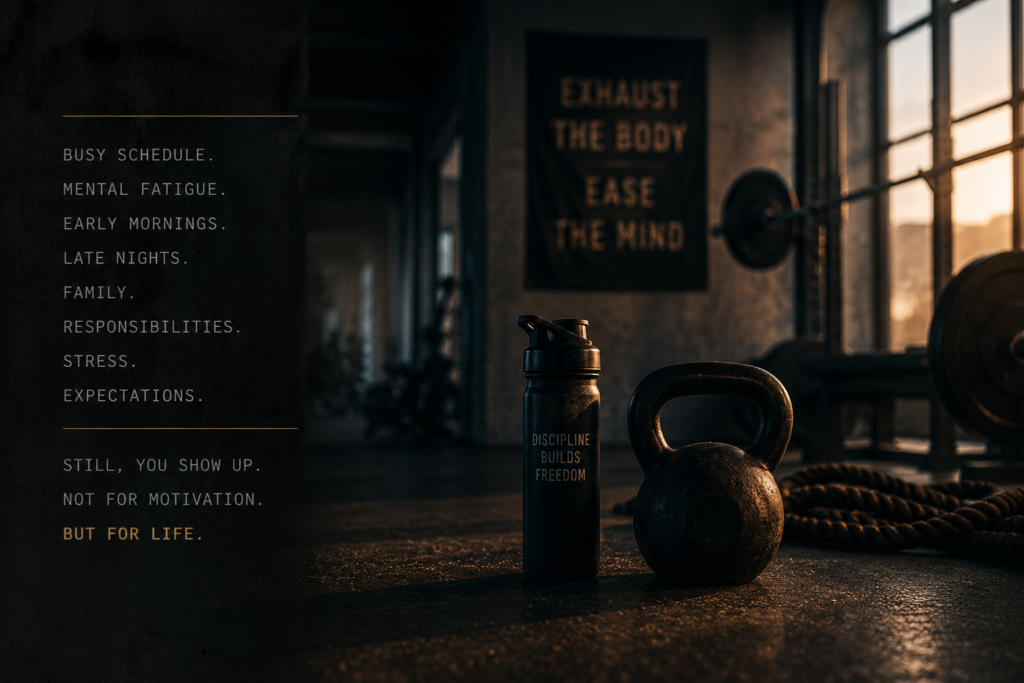
Exhaust the body, ease the mind.
For me, staying fit with a full-time job is not really about having extra time. It is about understanding that health has to become part of the structure that keeps everything else from falling apart.
Time Is Not Always The Real Problem
A lot of people say they do not have time to stay fit.
I understand that completely.
Between work, family, school, responsibilities, stress, and trying to have some kind of personal life, fitness can feel like one more thing fighting for space on an already full schedule.
But over time, I have realized that time is not always the real issue.
The bigger challenges are usually:
- mental fatigue,
- lack of structure,
- unrealistic expectations,
- poor sleep,
- inconsistent nutrition,
- and trying to do too much too fast.
For me personally, life is busy.
I work as a project manager. I go to school full time. I am married. I have a four-year-old. There are plenty of days where my schedule feels packed from the moment I wake up until the moment I go to bed.
But I still make health a priority because I know what happens when I do not.
When I stop training, sleep poorly, eat without structure, and let stress control my habits, I do not feel more free.
I feel worse.
My energy drops.
My mood changes.
My focus gets weaker.
My anxiety gets louder.
That is why fitness cannot just be something I do when life is easy.
It has to be something I protect when life gets hard.
You Do Not Need Perfect Workouts
One of the biggest mistakes people make is thinking fitness requires perfect routines.
They imagine they need:
- two hours in the gym,
- a flawless meal plan,
- intense training every day,
- perfect motivation,
- and massive life changes all at once.
That is usually why people quit.
The expectations are too unrealistic.
Over the years, I have learned to adapt my workouts to my life instead of expecting my life to always adapt to my workouts.
Sometimes that means lifting heavy.
Sometimes it means intense cardio.
Sometimes it means a shorter workout.
Sometimes it is just a 30-minute jog because that is what the day allows.
But something is almost always better than nothing.
That mindset matters because consistency wins long term.
That is also why discipline matters more than motivation when life gets busy and your energy is low.
You can have one bad day and still be on track. The real problem usually starts when one bad day turns into multiple bad days in a row, and then people try to “catch up” with extreme workouts or extreme dieting.
That cycle is exhausting.
Fitness works better when it becomes sustainable.
Not perfect.
Sustainable.
Sleep And Nutrition Matter More Than People Realize
When I was younger, I put most of my focus on training hard.
And training matters.
But over time, I have learned that sleep and nutrition are the foundation. You can train as hard as you want, but if sleep and nutrition are constantly neglected, progress becomes much harder than it needs to be.
I prioritize sleep because I know how much it affects everything else:
- energy,
- mood,
- recovery,
- focus,
- hunger,
- discipline,
- and stress.
I’ve learned that recovery is not something separate from discipline. It is one of the main things that makes discipline sustainable long term.
Nutrition works the same way.
I do not think people need to overcomplicate eating, but they do need some structure. If there is no structure, it becomes easy to drift into habits that work against your goals.
For me, staying fit is not about chasing perfection with food.
It is about understanding that what I eat and how I recover directly affect how I show up in the rest of my life.
That includes work.
Family.
School.
Training.
Mental health.
Everything.
Fitness Is Not Just About Appearance
A lot of people start fitness because they want to look better.
There is nothing wrong with that.
But I think the deeper value of fitness shows up mentally.
For me, fitness is one of the best tools I have for managing stress. No matter how mentally drained I feel, physically challenging myself almost always helps calm my thoughts.
There is something about lifting heavy, pushing through intense cardio, and forcing my body to work hard that helps reset my mind.
It gives the stress somewhere to go.
On rough days, I can sit around and replay everything that happened, or I can go physically challenge myself and give my mind a chance to settle.
I have done both.
And most of the time, when I give in to doing nothing, I feel worse the next day. But when I force myself to train, even when I do not feel like it, I usually come back calmer, clearer, and more focused.
That is why fitness became bigger than appearance for me.
It became a way to stay mentally grounded.
“It is exercise alone that supports the spirits, and keeps the mind in vigor.”
— Marcus Tullius Cicero
The Mental Fatigue Is Real
Busy people are not always physically tired.
A lot of the time, they are mentally exhausted.
That is a different kind of fatigue.
After a long day of problem-solving, decision-making, meetings, emails, phone calls, and pressure, your brain can feel like it has nothing left to give.
That kind of mental overload is one of the biggest reasons modern life feels mentally exhausting for so many people.
That is the moment where discipline matters.
Not fake motivation.
Not excitement.
Not waiting until you suddenly feel inspired.
Discipline.
Because the truth is, there will be days where you do not want to move. There will be days where the gym feels inconvenient. There will be days where your mind tries to convince you that skipping is the easier option.
And sometimes rest is the right answer.
But other times, what you really need is not another night of sitting in stress.
You need to move.
You need to get out of your head.
You need to exhaust the body so the mind can finally ease up.
Build A Routine That Actually Fits Your Life
The best fitness routine is not the one that looks impressive online.
It is the one you can actually repeat.
If you work full time and have a busy home life, your routine has to be realistic.
That may mean:
- shorter workouts,
- training before work,
- training after work,
- walking during breaks,
- meal prepping simple foods,
- protecting sleep,
- reducing screen time before bed,
- or making movement non-negotiable in some form.
For me, going straight to the gym after work helps.
If I go home first, it becomes much easier to talk myself out of it. The couch gets comfortable. The day starts catching up with me. My mind starts negotiating.
So I remove the negotiation.
I go straight there.
That is one of the ways discipline creates freedom. It removes constant decision-making and gives your day more structure.
That one decision makes the habit much easier to maintain.
I think that is what people need to understand about staying fit with a full-time job. You have to remove as much negotiation as possible.
Do not make every healthy choice a daily debate.
Build structure so the decision is already made.
Consistency Beats Catching Up
One of the biggest traps people fall into is the idea that they need to make up for missed time.
They miss workouts, eat poorly for a few days, lose momentum, and then try to punish themselves back into progress.
That rarely works long term.
A better approach is to simply get back on track the next day.
One bad day does not ruin progress.
But letting one bad day turn into a pattern can.
Consistency is not about never messing up. It is about returning to the routine quickly enough that one bad decision does not become your new normal.
That applies to fitness, nutrition, sleep, stress, and mental health.
The goal is not perfection.
The goal is returning.
Final Thoughts
Staying fit with a full-time job is not easy.
But it is possible when you stop thinking fitness requires perfect conditions.
You do not need endless free time.
You do not need perfect motivation.
You do not need a flawless routine.
You need structure.
You need consistency.
You need sleep.
You need realistic expectations.
You need enough discipline to show up when life gets busy.
For me, fitness is one of the main ways I protect my mental health, energy, confidence, and focus.
It helps me handle stress.
It helps me stay grounded.
It helps me show up better in the rest of my life.
And sometimes, the days where you least feel like taking care of yourself are the days where you need it the most.
Exhaust the body, ease the mind.
Pace your purpose. Drive your future.